



The words " ash " or " minerals " displayed on food products do not refer to burnt paper or cigarette butts. Rather, they refer to the remains of food that have completely burned. This term is used to indicate the amount of minerals present in dog food.
Mineral materials contain:
- magnesium
- phosphorus
- potassium
- sodium chloride
In addition to these elements, there is also calcium, the concentration of which exceeds that of the others.
Raw ashes
To determine the crude ash content, you must look at the percentage marked before this heading or the "minerals" heading. This is because ash is obtained after the food has been completely carbonized under a high heating temperature.
What are the important minerals?
Crude ash is divided into two main groups: macro-elements and trace elements. The concentration of these substances varies. While the former are present in enormous quantities, the latter are present in smaller amounts.
In the category of macroelements, calcium occupies first place. This ranking is due to its large quantity and consistent presence. Next come the other minerals, listed below.
As for trace elements, they include zinc, iron, and manganese. Copper and iodine are also present in significant amounts. Selenium is also among these micronutrients.
What is the role of minerals in a dog's nutrition?
Whether trace elements or macro-elements, they play an important role in a dog's well-being. Their essential functions are:
- The maintenance and development of all tissues
- The regulation of physiological and biological mechanisms
- The design of hormones and enzymes
In their primary function, the minerals contained in raw ash protect both soft and hard tissues, ensuring the viability of the tissue system. Their secondary function highlights the specific attributes of each element (macro or trace). In other words, they provide various essential benefits to the dog's body.
How to establish a good dog diet?
Several criteria help guide you towards high-quality dog food. Among them is the crude ash content. Although it's an indirect characteristic, the concentration is crucial for the pet's good physical condition. For this reason, a maximum of 6 to 10% crude ash is recommended in dried products .
However, for foods containing moisture, the total nutrient content must be between 1.25% and 2.5%. Dog food is the most suitable for complying with this regulation.
Indeed, these are the standards required to achieve an acceptable nutritional value. If the imposed limits are not met, the dog may produce white, very hard stools. Chronic constipation may also occur.
Therefore, the wet food not recommended for your dog contains 3% crude ash. The moisture content is 82%. The estimated carbohydrate content is 0.7%. As for crude protein, crude fat, and crude fiber, their levels are 9.5%, 4%, and 0.8%, respectively.
Is there a link between urinary problems and raw ash?
The development of kidney stones in your dog can be a direct result of high mineral levels. Excess minerals can form crystals, which can quickly cause blockages in the urinary system.
To address this, the ideal choice is a dry matter content of at least 10% for treats. However, the moisture content should be 8%. Soaked food, on the other hand, should have a moisture content of 78% and a crude ash content of 1.1%.
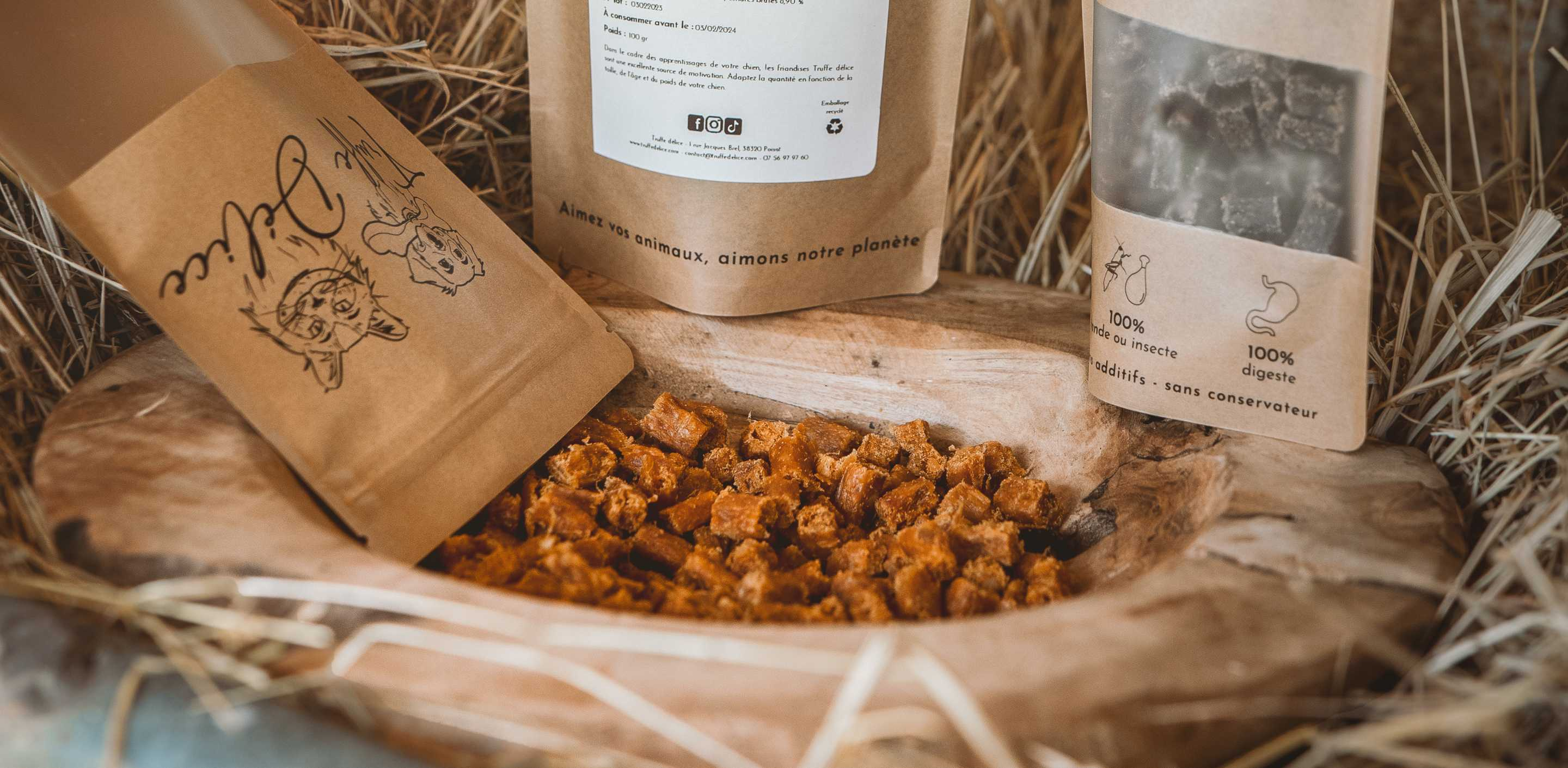
What is the crude ash content in Truffe Délice candies?
At Truffe Délice, we are vigilant about the amount of crude ash in our products. All of our products have less than 10% crude ash.
>> If you'd like to see part of our wonderful collection of healthy treats for your furry friend: Dog Treats – Truffle Delight
In conclusion, raw ash is an important component to monitor closely when making a good dog treat. By doing so, you avoid any unpleasantness for your four-legged friend.
>> To learn more about labeling requirements for dog food .